
The Art of the Glide and How to Time Your Kick Perfectly
Why Breaststroke Timing and Glide Can Make or Break Your Swim
Breaststroke timing and glide is the single biggest factor separating a smooth, efficient stroke from one that feels like hard work going nowhere.
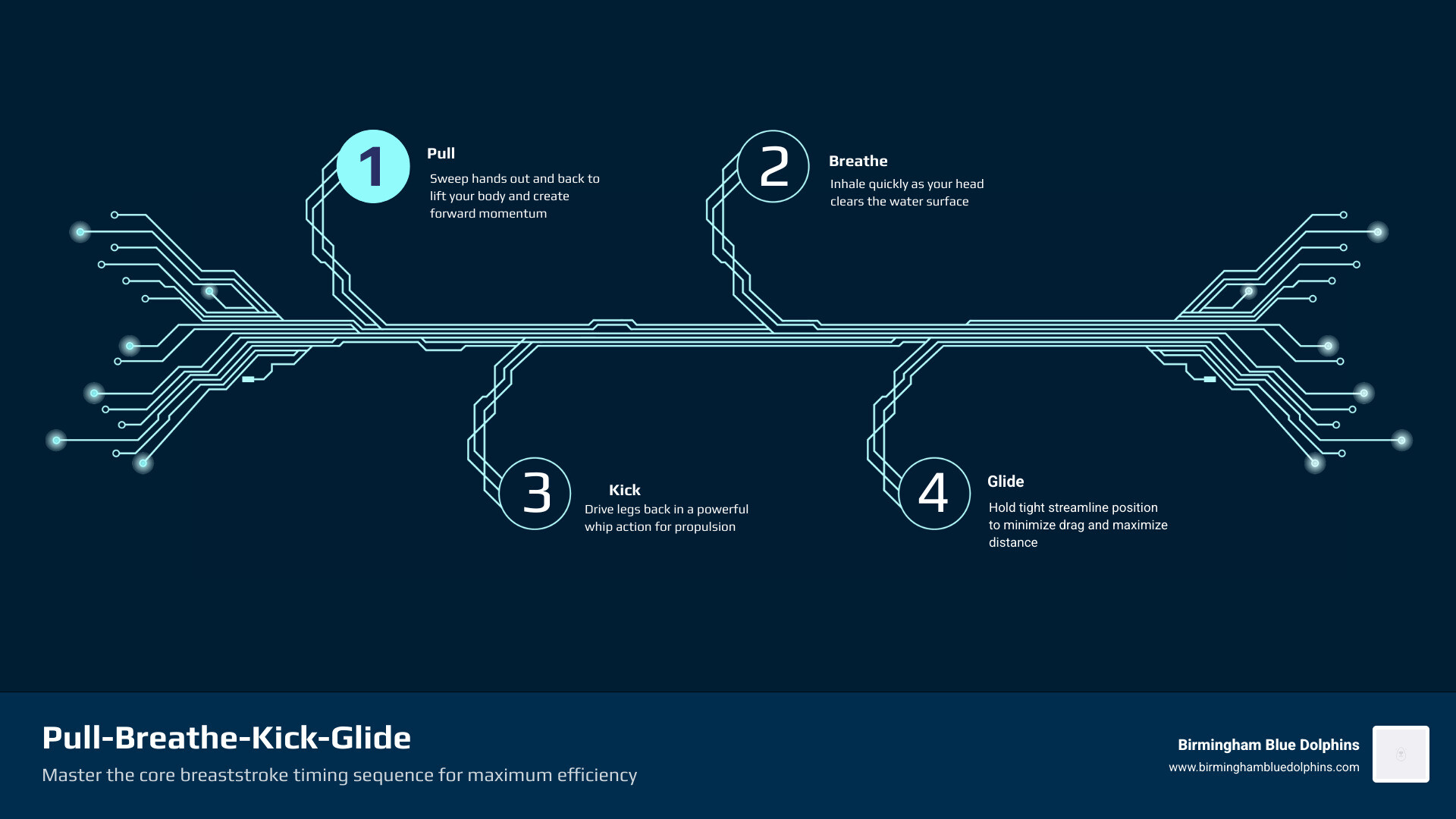
Here is the core sequence every swimmer needs to know:
- Pull – sweep your hands out and back to lift your body
- Breathe – inhale as your head clears the water
- Kick – drive your legs back in a powerful whip action
- Glide – hold a tight streamline until you feel your speed begin to fade
That four-step rhythm is the heartbeat of breaststroke. Get it right, and the stroke feels almost effortless. Get it wrong, and even strong swimmers can feel like they are swimming through mud — or worse, barely moving forward at all.
Breaststroke is unique among the four competitive strokes. It has a stop-start quality that no other stroke has. That glide phase is not wasted time — it is where your body cashes in on the power your kick just generated. But hold it a beat too long, or cut it short too soon, and you lose all that momentum.
As one coaching perspective puts it, breaststroke is more art than science. The timing has to be felt as much as it is taught.
The good news? Even if timing does not come naturally to your child, it can absolutely be learned — with the right drills and a clear understanding of how each phase connects to the next.
The Mechanics of breaststroke timing and glide
To master breaststroke timing and glide, we must first understand that breaststroke is a “short-axis” stroke. Unlike freestyle or backstroke, which rely on long-axis rotation, breaststroke is built around a pivoting motion at the hips. This creates a unique challenge: every time we recover our arms and legs, we create massive amounts of frontal drag.
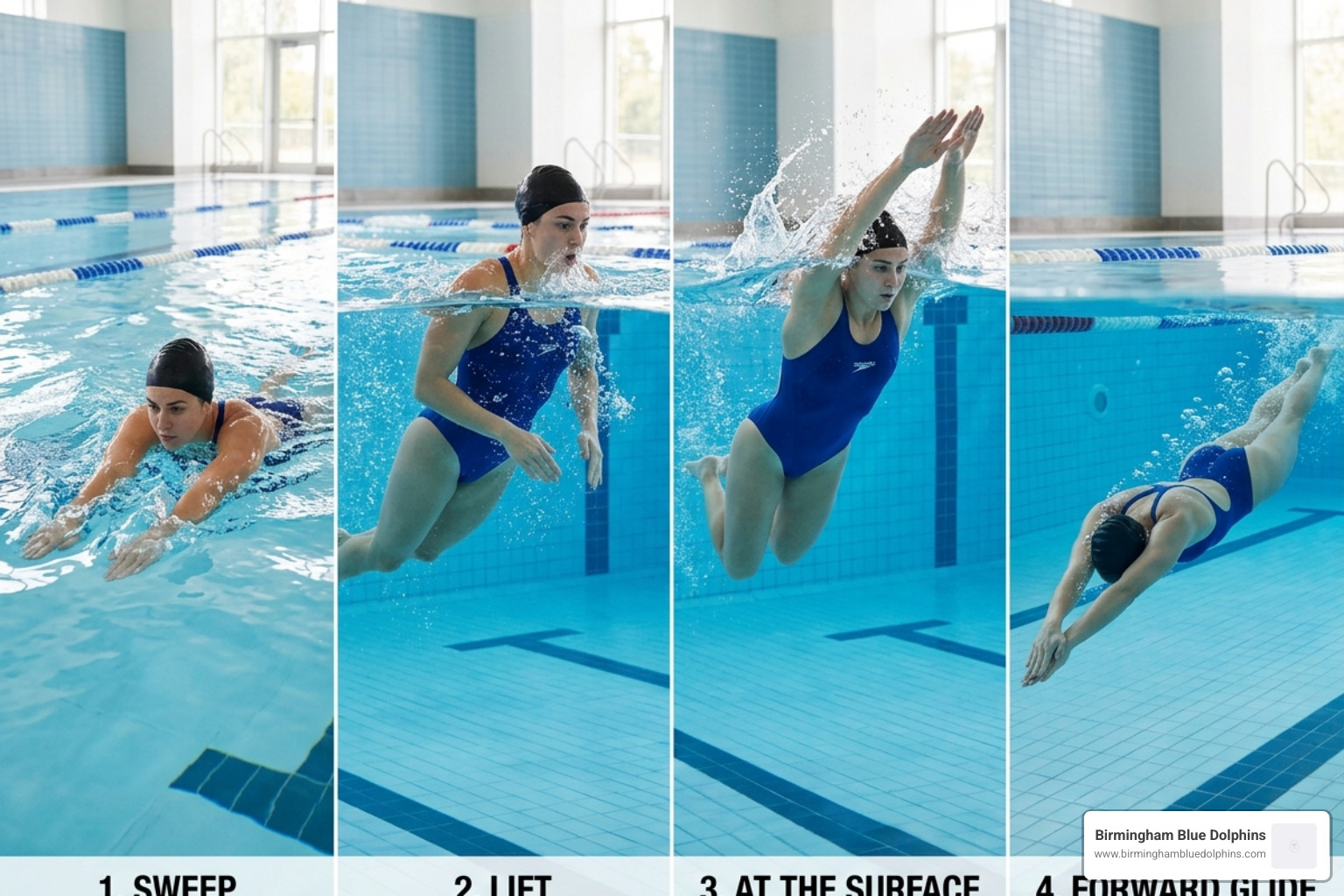
The goal of elite timing is to minimize the duration of that drag while maximizing the duration of the “power” phase. We often use the S.L.A.F. framework to help our swimmers visualize this: Sweep, Lift, At the surface, and Forward glide.
Momentum and Overlapping Propulsion
One of the biggest myths in swimming is that the pull and kick should be completely separate. In reality, modern breaststroke timing and glide relies on a controlled overlap. If you wait until your arms are fully extended to start your kick, you create a “dead spot” where your momentum drops to zero.
Instead, we teach our swimmers to initiate the leg recovery (bringing the heels toward the seat) during the “Lift” phase of the pull. By the time the hands are “shooting” forward at the surface, the legs are ready to snap back. This ensures that propulsion from the kick begins just as the drag from the arm recovery ends. According to Scientific research on breaststroke kinematics and efficiency, maintaining a continuous flow of movement is the most effective way to reduce the energy cost of the stroke.
Mastering the breaststroke timing and glide Sequence
The sequence follows a specific rhythm: Pull-Breathe-Kick-Glide. Let’s break that down into the finer details:
- Scull-Scoop-Shoot: The pull starts with a scull (hands moving out at roughly a 40-degree angle), moves into a scoop (elbows high, hands coming together under the chin), and finishes with a shoot (hands thrusting forward into streamline).
- High-Elbow Catch: To lift the body for a breath without sinking the hips, we keep the elbows high. This allows the forearms to act as paddles, pulling the upper body up and forward.
- Inhalation Timing: You should inhale at the peak of the “scoop.” As your hands come together, your chest is at its highest point.
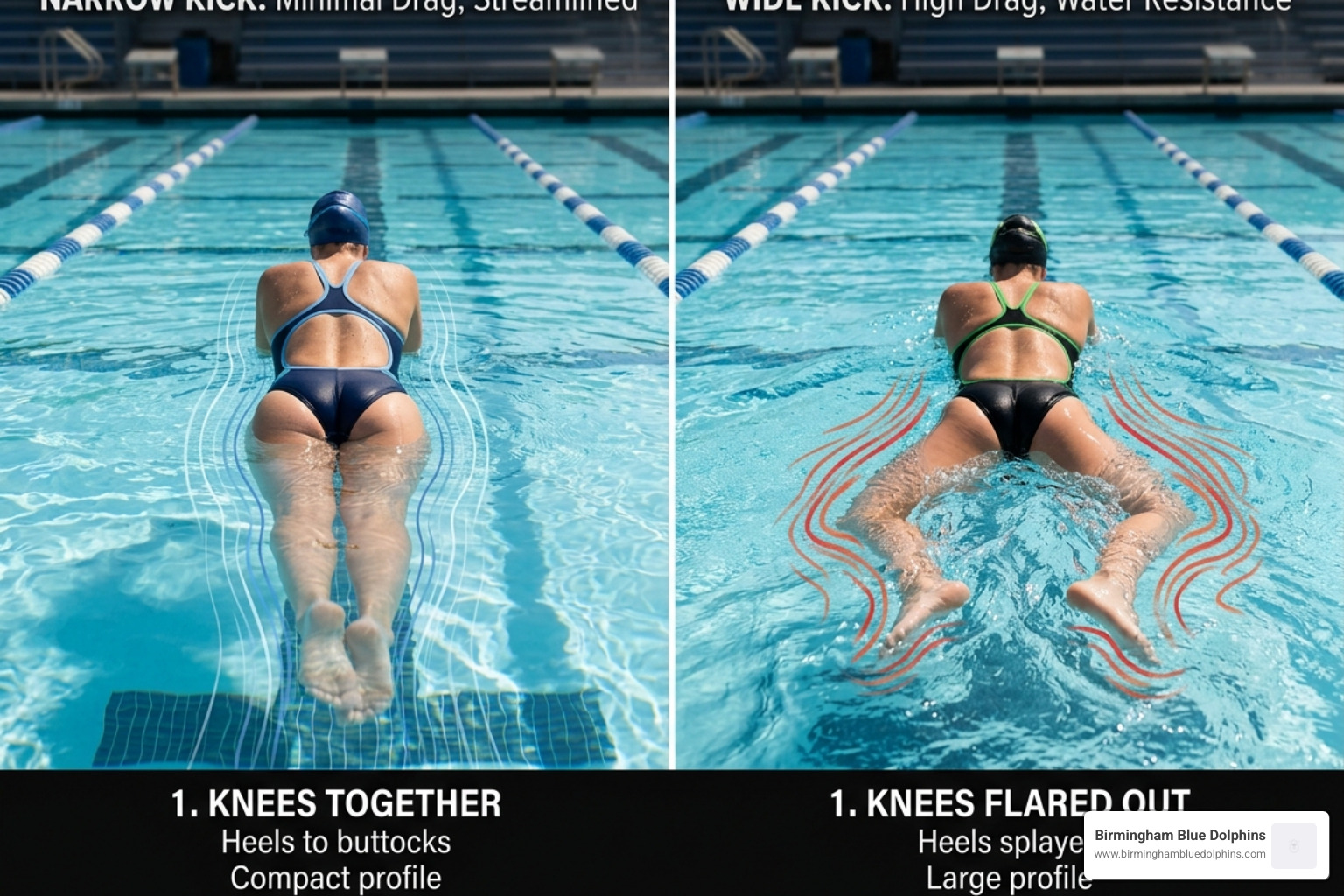
- Heel Recovery: Avoid pulling your knees to your chest, which creates a “parachute” effect in the water. Instead, bring your heels to your buttocks.
- Hand Recovery Speed: Your hands should “skate” across the surface of the water. The faster the hands recover, the sooner you can get back into that beautiful, drag-free glide.
Why breaststroke timing and glide is Critical for Efficiency
In breaststroke, the legs are the engine. While freestyle relies heavily on the arms, a strong breaststroke kick provides roughly 75-80% of your forward movement.
However, even the strongest kick in the world won’t help if your timing is off. If you kick while your arms are still pulling back, you are essentially slamming on the brakes while trying to accelerate.
We also have to consider the “11lb Head Rule.” The average human head weighs about 11 pounds. In breaststroke, we use that weight to our advantage. By driving the head forward and down into the glide phase, we convert that weight into kinetic energy, helping to “propel” the body forward.
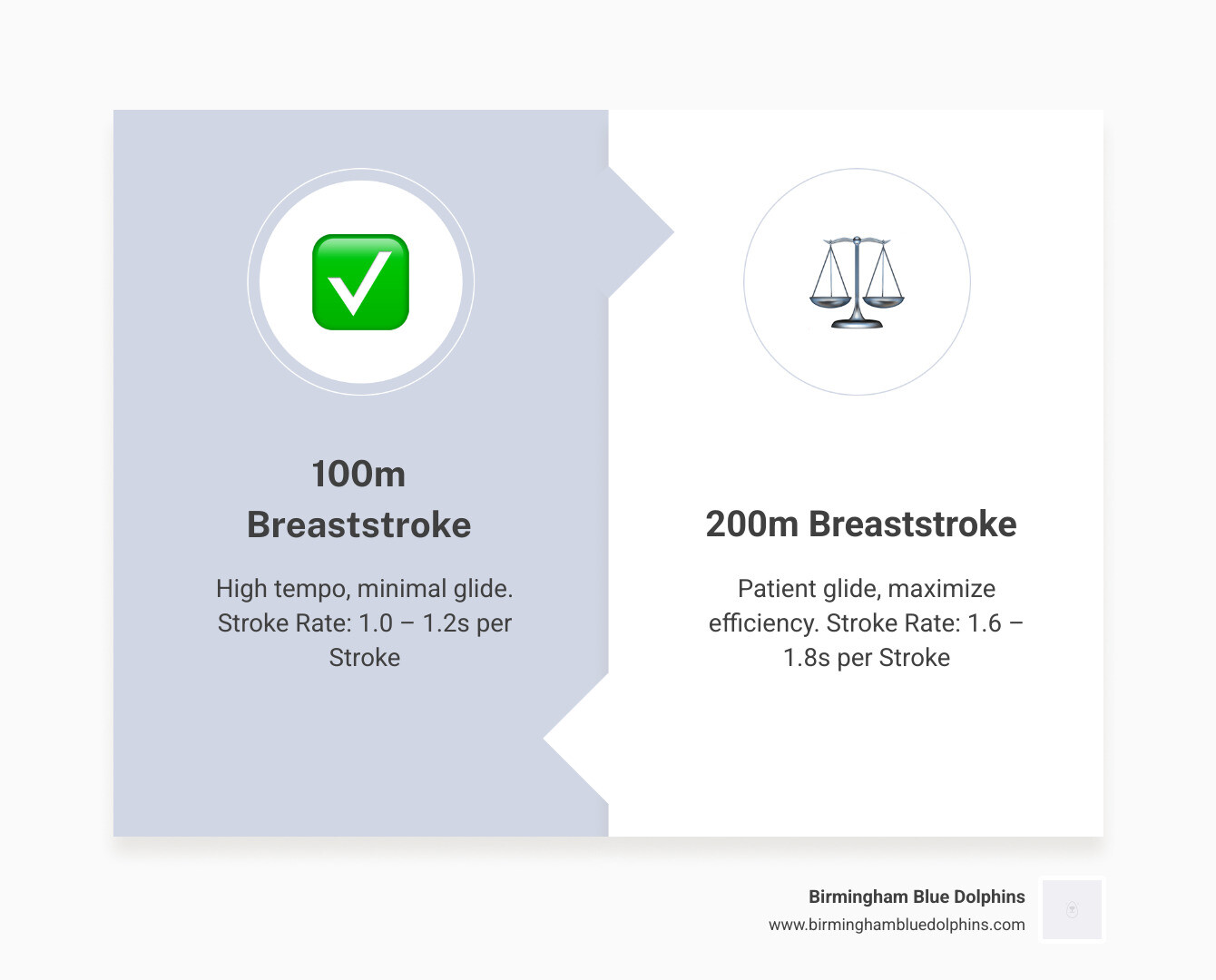
| Event | Stroke Rate (Seconds per Stroke) | Focus |
|---|---|---|
| 100m Breaststroke | 1.0 – 1.2s | High tempo, minimal glide |
| 200m Breaststroke | 1.6 – 1.8s | Patient glide, efficiency |
Optimizing the Glide Phase for Maximum Distance
The glide is where the magic happens. It is the most efficient part of the stroke because your body is in its most streamlined shape. To maximize this, we focus on “hyper-streamlining.”
- Elbows Tight & Biceps Up: A pro tip we use at Birmingham Blue Dolphins is to “screw” your elbows inward during the glide. This forces your biceps to face upward and keeps your arms tucked tight against your ears, preventing your elbows from flaring out and creating drag.
- Horizontal Alignment: Your hips should stay high, near the surface. If your hips sink, your legs will drag behind you like an anchor.
- Deceleration Cues: How long should you hold the glide? You should hold it until you feel your forward speed begin to decelerate. For a 200m swim, this is usually about 1.5 to 2 seconds. For a 50m sprint, the glide is almost non-existent.
- The “No Man’s Land”: This is the moment when your hands are moving forward but haven’t yet reached full extension. You must move through this phase as quickly as possible to avoid a “dead spot” in your momentum.
Common Timing Mistakes and Technical Fixes
Even experienced swimmers fall into bad habits. Here are the most common issues we see with breaststroke timing and glide and how we fix them.
- Early Kicking: Many swimmers start their kick while their arms are still in the “pull” phase. This creates massive resistance.
- The Fix: Focus on the “Shoot.” The kick should only snap shut after the hands have started their forward journey.
- Over-Gliding: While we love a good glide, holding it until you stop moving completely is a mistake. You then have to use double the energy to get moving again.
- The Fix: Use stroke counting. Try to find the “sweet spot” where you maintain a consistent speed across the pool.
- Wide Knees: If your knees are wider than your hips during the kick, you’re creating a wide profile that slows you down.
- The Fix: Keep the knees narrow and focus on a “whip” action with the feet.
- Dropped Hips: This usually happens when a swimmer lifts their head too high to breathe.
- The Fix: Lift your shoulders to breathe, not just your neck. Keep your eyes looking slightly down and forward, not at the ceiling.
Advanced Drills to Perfect Your Rhythm
To truly master breaststroke timing and glide, you need to take the stroke apart and put it back together. Here are our favorite drills used at Birmingham Blue Dolphins.
- The Add-a-Kick Drill: This is a variation of the classic “two kicks, one pull.” Push off in a streamline and take one quick kick. Then, perform a full stroke (pull-breathe-kick) and hold the glide. This forces you to focus on the connection between the kick and the glide.
- Head Up, Heels Up, Snap: This drill focuses on the recovery. By keeping your head up, you can watch your hand recovery and ensure your heels are coming up to your seat at the exact moment your hands “shoot” forward.
- The Water Woggle Coordination: For beginners struggling with the sequence, we sometimes place a pool noodle (water woggle) under the arms. This keeps the upper body buoyant so the swimmer can focus entirely on the “pull-then-kick” alternation without worrying about sinking.
- Glide-to-Glide Practice: We ask our swimmers to see how few strokes they can take to cross a 25-meter pool. This encourages them to “ride the glide” and find the most efficient body position.
If you are looking for personalized feedback on these drills, More info about swim training services is available on our main site.
Conclusion
At Birmingham Blue Dolphins, we believe that mastering the breaststroke timing and glide is about more than just speed—it’s about finding the “art” in the water. Whether you are aiming for a podium finish in the 2026 championships or simply want to swim with more ease, focusing on your rhythm is the fastest way to see results.
By minimizing drag, utilizing the weight of your head, and being patient in the glide, you can transform your breaststroke from a struggle into a powerhouse of efficiency. Every body is different; what works for a 50m sprinter will look very different from a 200m specialist.
Key Takeaways for Your Next Practice:
- Heels to Seat: Don’t bring your knees to your chest.
- Fast Hands: Recover your arms as quickly as possible to get back to streamline.
- Ride the Glide: Don’t rush the next stroke; wait for the deceleration cue.
- Symmetry is Key: Ensure your pull and kick are balanced on both sides.
For more technical insights, you can explore the Scientific research on drag reduction in competitive swimming.
Frequently Asked Questions
How long should I hold the glide? It depends on the distance! For a 200m race, aim for 1.5 to 1.8 seconds. For a 100m, keep it closer to 1 second. The golden rule is to start the next pull just as you feel your speed beginning to drop.
Why do I feel like I’m moving backward? This usually happens because of “simultaneous timing.” If you pull and kick at the exact same time, the drag from your arms cancels out the power from your legs. Focus on the sequence: Pull, then Kick.
How does timing change for a 50m sprint? In a sprint, “patience” goes out the window. The glide phase is significantly shortened to maintain a high stroke rate, but the sequence (pull-breathe-kick) must remain identical to avoid disqualification or massive drag.
For those ready to dive deeper into their training, More info about our swimming academy can help you find the right program for your goals. Happy swimming!
